

The Acropolis - Part Two - The Erechtheion And The Missing Sister
- Ben Parker
- Jul 15
- 4 min read


While the Parthenon is one of the most famous buildings in the world, there is another building on the Acropolis, perhaps equally as admired and discussed, yet not without controversy. That building, of course, is the Erechtheion.
In the early 1800s, British diplomat Lord Elgin shipped 170 crates of marble from the Acropolis back to Britain, claiming to have had authority to do so by the leaders at the time, while Greece was under the control of the Ottoman Empire. While initially intending on adding the friezes, statues and frescoes to his own private collection, bankruptcy led him to sell the items to the British Government, and the items have been housed in the British Museum ever since. (The issue is a lot more complicated than I have laid out so please forgive my brief summary of the dispute).
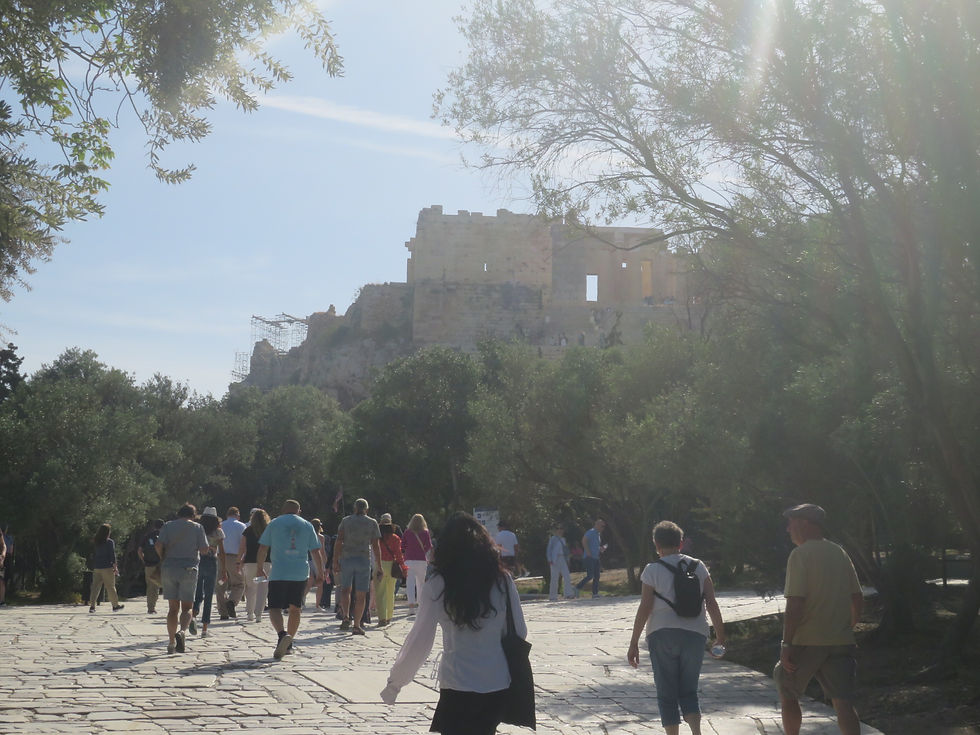
Numerous attempts to restore the Pentelic marble back to its native land have been fruitless, and it is a discussion that continues to this day. Yet as I walked across the Acropolis, toward the Erechtheion, this time it wasn't the striking Ionic columns that caught my eye, but six female statuette columns holding up the south porch. These sisters, 'The Caryatids', are as much of a fixture of the Acropolis as the Parthenon itself.


As I stared upon this incredible example of Ancient Greek architecture, I felt two overriding things at once. The first, being a predictable sense of awe, to see such an iconic site with my own eyes. And the second was a sadness, pondering the fate of these incredible artefacts.
If you were to do what most tourists do after visiting the Acropolis, and visit the Acropolis Museum, you would be able to see the original Caryatids, the highlight of the entire multi-million pound, state of the art facility. Yet it wouldn't take long to realise there are only five, or spot the empty space kept upon the pedestal. For amongst the artefacts which were sent back to Britain by Lord Elgin, was one of the six Caryatids, separating these sisters by almost two thousand miles.


I hope one day all the Elgin marbles will be restored to Athens, close to the Pentelicus mountains from which they were mined. Yet despite the controversy surrounding this temple, it remains one of the most incredible features of the Acropolis, and also introduces one of my favourite Greek myths.

The first mythic king of Athens was a man called Erechtheus, sometimes also labelled as Erichthonius. However, this temple was not dedicated to the first ruler of Athens alone, but also to the two Olympians who fought to become the patron deities of the city: Poseidon, the god of the sea, and Athena, the goddess of wisdom and war.
Before it was graced with the monuments still there to this day, the two Olympians competed upon the great rock to be the patron deity of the region by offering gifts. Poseidon presented a great water fountain, bursting out of the rock. Yet the saltwater made its use purely decorative. Athena, however, made a great olive tree burst up from the ground, ripe with green leaves and with fruit. The king and his court could instantly see the benefits of olives, olive oil and olive wood. The city was named Athens in her honour and forever became synonymous with her symbol: the owl.
One of the things I was most excited to see during my visit was the great olive tree at the side of the Erechtheion, keeping myth alive to this day. And when I stood there, my gaze drifting between the incredible views of the city, the incredible architecture and the majesty of this old tree, it felt like a place where such a story could truly have happened.


This adoption of the goddess Athena in the aftermath of the Persian Wars is further highlighted by the third standing temple on the Acropolis, the Temple of Athena Nike, merging the goddess of war with the Greek goddess of victory.
The temple was built between 426 and 420 BCE, and remains remarkably well preserved. The temple stonework contains elaborate scenes of the Olympian gods, as well as military victories such as the Battle of Marathon. Most of these pieces reside in the Acropolis Museum. However, like the Caryatids, the original south frieze today resides in London in the British Museum.


The connection between myth and history, and how one informs and influences the other, is something that will never fail to fascinate and move me. The next post in this series will explore more of the sites on the way down of the Acropolis, as well as another site of great mythological significance.


Comments