

The Acropolis - Part Three - The Slopes, The Cave Of Pan and The Acropolis Museum
- Ben Parker
- Jul 16
- 4 min read


There is nothing quite as bittersweet as beginning to walk back down the Acropolis, turning your back to the Parthenon. But the sadness is soothed somewhat as you stare out across the city, or study the intricate marble laid out on all sides. Everywhere I looked, there was something that made me pause. But as I traced the metal steps down the North Slope, I soon felt only excitement. That is because there was another site of mythological importance that I had been longing to see. For anyone who is reading my blog for the first time, it's worth recapping just a bit.


While the Olympian twelve were the most prominent deities in the Ancient Mythological world, there were, of course, others. One of those deities was the goat-footed Pan, the god of the wild. Shunned in most Olympian circles for his horns and odd ways, this son of Hermes became entwined with the Athenian victory over the Persians in the Battle of Marathon in 490 BCE. For it was believed that the god, from whose name the word 'panic' derives, bellowed from his cave in the region of Oinoe, creating such an effect in the Persians, who swiftly retreated.
Following this event, many caves in the region became places of worship for the god, with the cave of Oinoe being the most celebrated. However, there was another cave site, much closer to the city, which too would become synonymous with this unlikely symbol of military victory: the cave of Pan on the North Slope of the Acropolis.

Whilst by no means a large cave, this site, like Oinoe, became a vital place of pilgrimage and worship. I couldn't conceal the grin on my face as I saw it. It's such an unassuming spot you could easily miss, yet I could just imagine Pan sat in the cave entrance, playing his flute as he looked out on the city.


While this cave site is a symbolic attraction, it was not the only one, with further caves also dedicated to Zeus and Apollo. The structures built around this kind of terrain made it clear the close relationship between caves and cult worship in the ancient Greek world.


After spending time staring up at the cave of Pan, I decided to use the rest of my time on the Acropolis walking slowly, taking in the significance of the sites around me. All along the grounds, you see evidence of thousands of years of history all crammed together in one place, living in harmony. From cults, to Roman baths, and Byzantine churches.
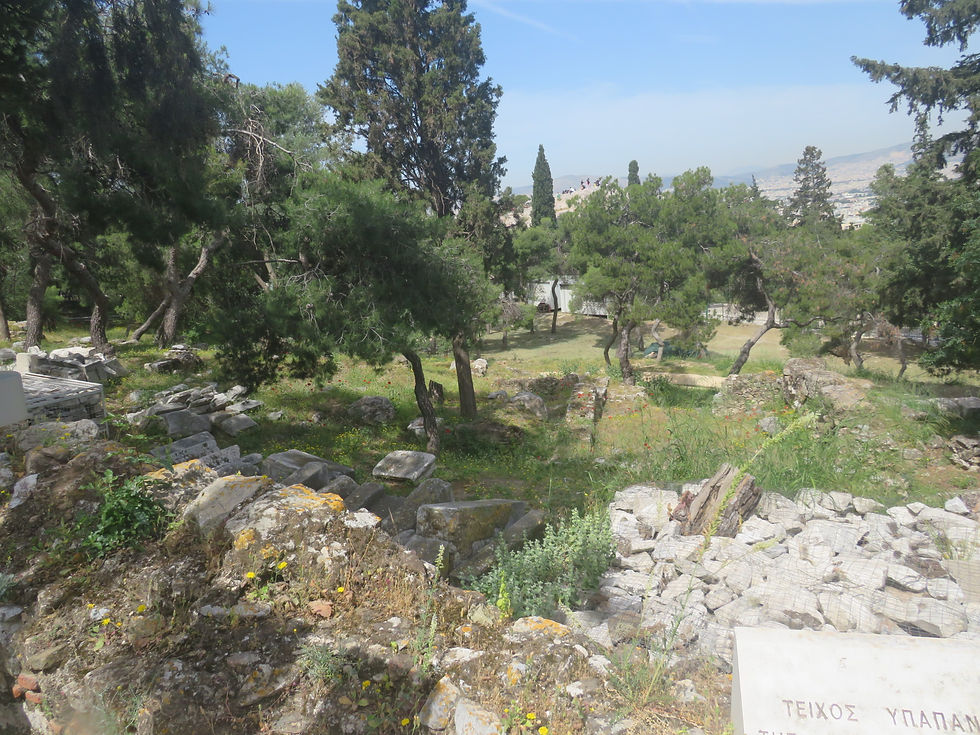


After exiting the gates, I decided to go on an adventure of my own, walking through the lower reaches of the Acropolis through the trees, the area all can access without a ticket. I walked through a line of olive trees, the sun piercing through and wild flowers all around me. The speed at which I went makes it hard to identify all the photographs I took, but I've tried to label them as accurately as I can.
I moved through the trees on the lower slopes, through the Shrine of the Nymphs, emerging by the modern steps to the Odeon of Herodes Atticus, and the Roman Cistern on the other side.


However, despite being able to see the most incredible sites the Acropolis and Athens had to offer, I do have a regret from my visit. Due to time constraints and entering the Acropolis on the North Slope entrance, I completely bypassed the Theatre of Dionysus. Once I realised, after seeing the cave of Pan, I tried to get to the spot, but the heat, confusion and time constraints worked against me, and all I was able to do was get a photo of the playwright Menander which lives just before the theatre itself. And I only achieved this due to the incredible zoom features of my camera. But I won't dwell too long on missing out on the site, I will simply add it to the many reasons that I need to go back.
After our visit to the Acropolis, we went to the Acropolis Museum. However, my camera died just as we entered, so I was left to the power of my Android, and stealing photos from my wife's iPhone.


One of the most amazing things about the Acropolis Museum is not only the incredible artefacts that it houses, but the fact that it sits upon an ancient site of its own, preserved with such amazing ingenuity. This incredible site is what remains of an Athenian neighbourhood, spanning from the 4th century BCE to the 12th century AD. We were surrounded by history before we had even made it inside.


After seeing so many incredible artefacts in the museum, we were all pretty tired, hungry and ready to return to the hotel. But there was one more historic stop to conclude our first day trip into Athens. That site will be the focus of the next post.


Comments